Discovery of the vampiris bacillus
I Am LegendThe discovery of the vampiris bacillus is the decisive scientific breakthrough in Robert Neville’s investigation of vampirism. A microscopic organism, rather than a supernatural force, becomes the explanatory center of the vampire condition: the germ moves through blood, responds to the absence of blood by changing form, and can spread through environmental channels. The discovery gives Neville an answer to the centuries of vampire superstition, but its significance is bitterly double-edged, because he reaches the answer only after the plague has destroyed his society and left him without the knowledge or resources to cure those still living.
From Observation to Experiment
Robert Neville’s discovery grows out of sustained observation rather than a single stroke of intuition. His isolation forces him to turn the remnants of ordinary life into a laboratory, while the recurring behavior of the infected supplies a series of visible problems that traditional vampire lore cannot adequately explain. The existence of sunlight sensitivity, the aversion to garlic, and the nightly behavior of the vampires initially appear to belong to folklore, but Neville increasingly treats them as effects requiring physical causes. His investigation therefore moves from inherited rules to testable mechanisms.
The surrounding environment also enters his reasoning. A medical text explains that many bacterial diseases can be disseminated mechanically by flies and mosquitoes, and that strong sunlight kills many germs rapidly. These statements provide Neville with a framework in which infection, vectors, and environmental exposure can coexist. The mosquito he crushes after Ruth identifies it as one of several pests becomes a small but concrete reminder that the epidemic’s world is not organized only by human contact. Disease can travel through ordinary organisms and conditions that survive beyond the social structures devastated by the plague.
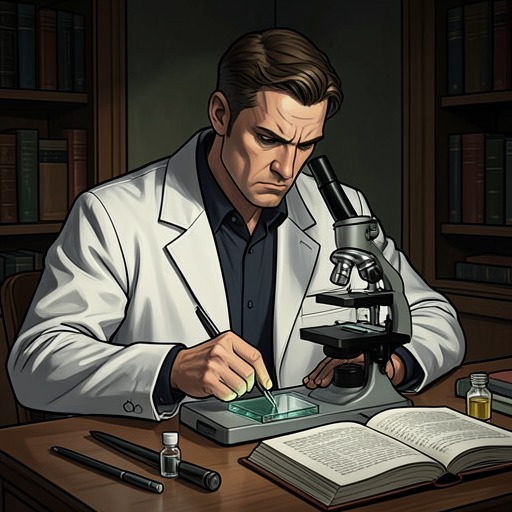
Neville then obtains a blood specimen from a woman and begins the painstaking process of preparing it for microscopic examination. It takes days to mount a few drops correctly, center the cell on the slide, and bring the specimen into focus. The thirty-seventh slide becomes the turning point. As he adjusts the spotlight, draw tube, mirror, diaphragm, and condenser, his expectation gathers around the possibility that this examination will finally disclose the nature of the infection.
Identifying the Germ
Under the microscope, Neville sees what a virus would not permit him to see: a germ moving delicately across the slide. The observation confirms that the disease is bacterial rather than viral. He names the organism vampiris, giving the previously shapeless phenomenon a scientific designation and converting the vampire from a figure of legend into a biological problem.
Further consultation of bacteriology texts identifies the organism as a bacillus, a cylindrical rod of protoplasm capable of moving through blood by means of tiny threads projecting from its cell envelope. These flagella lash through the fluid and propel the bacillus. The detail matters because Neville’s discovery is not merely the recognition of an invisible cause; it is an account of an active organism with a structure and mode of movement. The vampire body is not simply cursed or altered in an undefined way. It is occupied and governed by a living agent.
The sight of the bacillus collapses the explanatory authority of supernatural tradition. Neville understands that scientists had been correct to suspect bacteria, and that the germ inside the vampire is the murderer responsible for the condition. His own role is framed as an investigation completed by a lone survivor: at thirty-six, Robert Neville has traced the crime back to its physical agent. The language of an inquest gives the discovery a forensic force. He is not merely collecting facts; he is identifying the culprit in a catastrophe that has already claimed a civilization.
The Mechanism of Infection
The bacillus also helps Neville explain what happens when an infected body lacks blood. Without a supply of blood, the organisms metabolize abnormally, absorb water, swell, and ultimately explode, destroying the cells around them. Sporulation becomes necessary to complete the model. Rather than remaining active in a dying body, the germ can enter a resistant form capable of surviving decomposition and dispersal.
Neville connects this process to the dust storms. Freed spores can be blown through the air and lodge in minute abrasions produced by scaling dust. Once inside the skin, a spore can germinate and multiply by fission. As the bacilli multiply, surrounding tissue is destroyed and channels become plugged with organisms. The destruction of cells and bacilli releases poisonous decomposed matter into healthy tissue, and the toxins eventually reach the bloodstream. The result is a complete chain from environmental exposure to internal infection.
This theory removes the need for the most familiar supernatural imagery. The disease can operate without bats fluttering against windows, vampires hovering over beds, or any other supernatural agency. The vampire remains real, but its reality is biological. Its true story has not been told because earlier observers mistook the visible consequences of infection for supernatural origins.
Limits and Consequences of the Discovery
The discovery gives Neville intellectual clarity while intensifying his despair. He has found the answer too late. Knowing the causative germ does not tell him how to cure the infected, and he admits that he knows little about bacteria. The gap between explanation and remedy becomes one of the discovery’s central consequences: science can identify the murderer without yet possessing the means to reverse the crime. Neville responds by forcing himself to study, turning helplessness into a renewed objective.
The new biological model also changes the meaning of later observations. The dog wandering on the lawn raises questions about dosage, daylight survival, and resistance. Neville wonders whether the animal carries only a small amount of bacilli and is not yet fully affected, while the garlic he places around milk and hamburger becomes both a protective measure and a possible barrier to the animal’s approach. His attempt to capture the limping dog is therefore shaped by the same disease logic that produced the microscopic discovery: infection is not a simple supernatural identity but a variable physical condition with uncertain stages and consequences.
The discovery does not free Neville from danger. He continues to live behind a peephole, refusing to watch the women who pose outside to entice him from the house, and he remains locked into a cycle of observation, sound, and defensive isolation. Ben Cortman still appears at the lawn and calls him out. Later, the dark cars, guns, axes, pikes, and spotlights of the new vampire society converge on Robert Neville’s house, and he is wounded, captured, and placed behind barred windows. The scientific explanation of vampirism thus precedes, but does not prevent, his political reversal: the man who studied the infected becomes an object of their surveillance and judgment.
Historical and Narrative Significance
Neville’s reasoning extends beyond the immediate epidemic. He compares the plague of 1975 with historical outbreaks such as the fall of Athens and considers whether earlier accounts of bubonic plague may also have recorded vampire-caused disease. The bacillus therefore creates a deep historical continuity. Vampirism is no longer an isolated modern anomaly but a possible explanation for recurring catastrophes that human beings had described through incomplete medical knowledge and supernatural language.
At the same time, the discovery exposes the limits of solitary knowledge. Robert Neville can name the organism, describe its movement, hypothesize its sporulation, and reconstruct its routes through dust and bodily tissue, yet he cannot convert that knowledge into collective recovery. His investigation separates truth from superstition, but it also leaves him more isolated: he understands the world’s mechanism while the world that might have used the understanding has disappeared.
The result is a reversal of the conventional vampire narrative. The vampire is not disproved by science; it is made more terrible by science because its reality becomes material, transmissible, and historically intelligible. Neville’s microscope turns a legend into a disease, but the disease continues to determine social order. By the time the new society captures him, his scientific achievement has not secured his authority. It has instead become part of the irony of his fate: the investigator who discovered what the vampire truly was is condemned by a transformed majority as the abnormal remnant of the old world.